Italy, as always, is wonderful. And I, as always, am distracted and going to ramble about something else altogether.
I was very pleased to see facebook full of "Happy Veteran's Day" etc. posts today. Whether or not you agree with the war(s) happening, the people standing face-to-face with their mortality should be thanked for their gusto. We need them to keep living the way we want to. So way to go, my generation, on not being mindless fools and blaming soldiers for the decisions of Washington. That's a change.
Also, thinking about this has made me kind of nostalgic and a little sad; my grandfather fought in Korea. I remember one of the last lucid conversations he had with me before he died: he told me some stories about the war. It was the only time I ever heard him talk about being a Marine, and one of only a handful of times I ever saw him get emotional (he was stoic to the end). I'm missing him a lot today, and wishing I could have known him as an adult. I could have learned so much from him. So. Grandpa, I love you and wish I had said that more often while I had the chance. Thank you for everything. We miss you.
On a final, lighter, note: is it "Veteran's Day" or "Veterans' Day"? I'm never sure. Also, happy 11/11/11, folks!
Friday, November 11, 2011

Thursday, November 3, 2011
Reflections on Firenze, Part I: Galleria dell'Accademia
There's just so much I could say about last weekend...I got to spend an incredible amount of time with Dief, I had a great pot luck with the people in my program, and I had an amazing time in lovely Florence. Naturally, the thing I'm most itching to write about is the art I was able to see, not least because one cannot take many pictures and I want a way of recording my thoughts (aided by pictures I'm stealing from Google, of course.) So I've recorded some of the highlights here.Disclaimer: none of you probably care about any of this. Sorry.
 The first museum we visited was the Galleria dell'Accademia, home to Michelangelo's David. Yes, the David is astounding, but there is also a ton of other incredible art in the Accademia that people seem to overlook. First of all, Fra. Bartholomeo's Prophet Isaiah (1516). Kind of a side-note, but I found this one interesting because of its similarities to Michelangelo's prophets in the Sistine. Pretty cool.
 Also, Lippi's Deposition from the Cross (1504-7). This is a work I studied pretty carefully for my art history class last winter, and it really struck me when I saw it in person because Mary (bottom left) is utterly green, which just doesn't transfer into photos and reproductions very well. She stands out against all the other, more realistically colored, figures, and her grief seems all the more real for her unreal coloring.
 Lippi's Annunciation, part of the same cycle as the Deposition, is also pretty cool. For one thing, it differs from many other annunciations, in which Gabriel is depicted as partially outside of the architecture housing the Virgin and also partially inside, signifying the breaking of the barrier between heaven and earth with the breaking of the pictoral frame. In Lippi's rendition, however, Gabriel is fully inside the architectural frame with Mary, though a separation is still delineated by the arcade of the middle ground and the pedestal holding Mary's book.
 I also particularly enjoyed Pieri's Deposition (1587) because of its motion. It has a very circular element, drawing the eye from the top left, at Mary's head, around the curve of her body toward the middle of the composition and Christ's head, and then along his body line around to his feet at the bottom left. The extreme tilt of Mary's head, echoing that of Christ, as well as the similarities in the positions of both of their right arms, clearly draws them apart from the other onlookers in the scene who reinforce, but do not replicate, the clockwise motion created by the Virgin and Christ.

One of my favorite things about the Accademia is the presentation of David as a kind of god. The layout of the room he is in mirrors the layout of a basilica, with a long nave and a transept, placing David, on top of an altar-like pedestal with expensive porphyry marble inlays, at their intersection (the place of the high altar of a basilica) in front of what can only be described as an apse. Where there would ordinarily be chapels or oratories in a basilica are placed Michelangelo's unfinished Prisoner sculptures. I absolutely love these. They give real insight into the way Michelangelo worked, and it's incredible to see markings in the stone, invisible in a polished, finished work, from his chisel. I could almost hear and see him working away on the marble as I stood in the museum. I felt as though the sculptures were about to come alive and step out of the marble, a la Pygmalion.
Of course David is amazing. I cannot even begin to put it into words, and I'm not going to try.
 The first museum we visited was the Galleria dell'Accademia, home to Michelangelo's David. Yes, the David is astounding, but there is also a ton of other incredible art in the Accademia that people seem to overlook. First of all, Fra. Bartholomeo's Prophet Isaiah (1516). Kind of a side-note, but I found this one interesting because of its similarities to Michelangelo's prophets in the Sistine. Pretty cool.
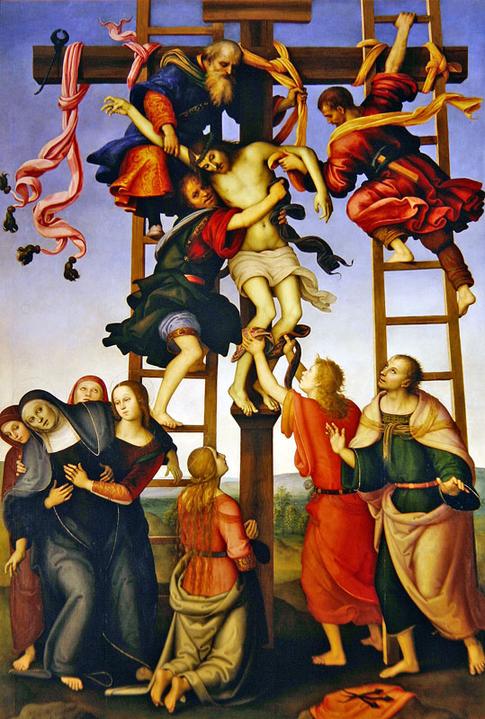 Also, Lippi's Deposition from the Cross (1504-7). This is a work I studied pretty carefully for my art history class last winter, and it really struck me when I saw it in person because Mary (bottom left) is utterly green, which just doesn't transfer into photos and reproductions very well. She stands out against all the other, more realistically colored, figures, and her grief seems all the more real for her unreal coloring.
 I also particularly enjoyed Pieri's Deposition (1587) because of its motion. It has a very circular element, drawing the eye from the top left, at Mary's head, around the curve of her body toward the middle of the composition and Christ's head, and then along his body line around to his feet at the bottom left. The extreme tilt of Mary's head, echoing that of Christ, as well as the similarities in the positions of both of their right arms, clearly draws them apart from the other onlookers in the scene who reinforce, but do not replicate, the clockwise motion created by the Virgin and Christ.
One of my favorite things about the Accademia is the presentation of David as a kind of god. The layout of the room he is in mirrors the layout of a basilica, with a long nave and a transept, placing David, on top of an altar-like pedestal with expensive porphyry marble inlays, at their intersection (the place of the high altar of a basilica) in front of what can only be described as an apse. Where there would ordinarily be chapels or oratories in a basilica are placed Michelangelo's unfinished Prisoner sculptures. I absolutely love these. They give real insight into the way Michelangelo worked, and it's incredible to see markings in the stone, invisible in a polished, finished work, from his chisel. I could almost hear and see him working away on the marble as I stood in the museum. I felt as though the sculptures were about to come alive and step out of the marble, a la Pygmalion.
Of course David is amazing. I cannot even begin to put it into words, and I'm not going to try.
Subscribe to:
Posts (Atom)