 The first museum we visited was the Galleria dell'Accademia, home to Michelangelo's David. Yes, the David is astounding, but there is also a ton of other incredible art in the Accademia that people seem to overlook. First of all, Fra. Bartholomeo's Prophet Isaiah (1516). Kind of a side-note, but I found this one interesting because of its similarities to Michelangelo's prophets in the Sistine. Pretty cool.
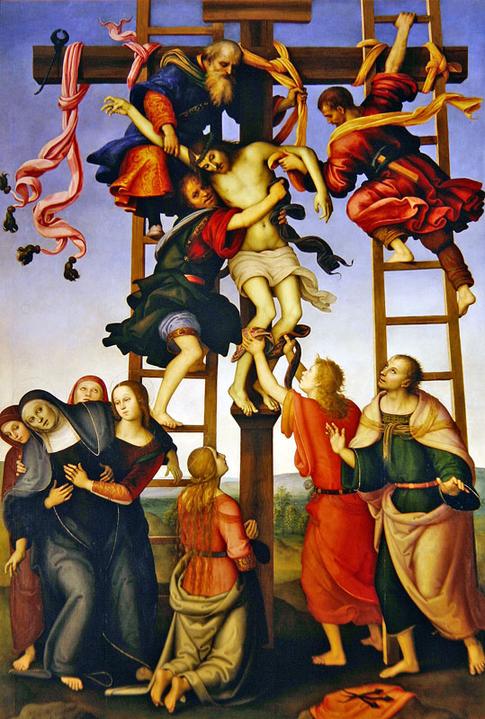 Also, Lippi's Deposition from the Cross (1504-7). This is a work I studied pretty carefully for my art history class last winter, and it really struck me when I saw it in person because Mary (bottom left) is utterly green, which just doesn't transfer into photos and reproductions very well. She stands out against all the other, more realistically colored, figures, and her grief seems all the more real for her unreal coloring.
 I also particularly enjoyed Pieri's Deposition (1587) because of its motion. It has a very circular element, drawing the eye from the top left, at Mary's head, around the curve of her body toward the middle of the composition and Christ's head, and then along his body line around to his feet at the bottom left. The extreme tilt of Mary's head, echoing that of Christ, as well as the similarities in the positions of both of their right arms, clearly draws them apart from the other onlookers in the scene who reinforce, but do not replicate, the clockwise motion created by the Virgin and Christ.
One of my favorite things about the Accademia is the presentation of David as a kind of god. The layout of the room he is in mirrors the layout of a basilica, with a long nave and a transept, placing David, on top of an altar-like pedestal with expensive porphyry marble inlays, at their intersection (the place of the high altar of a basilica) in front of what can only be described as an apse. Where there would ordinarily be chapels or oratories in a basilica are placed Michelangelo's unfinished Prisoner sculptures. I absolutely love these. They give real insight into the way Michelangelo worked, and it's incredible to see markings in the stone, invisible in a polished, finished work, from his chisel. I could almost hear and see him working away on the marble as I stood in the museum. I felt as though the sculptures were about to come alive and step out of the marble, a la Pygmalion.
Of course David is amazing. I cannot even begin to put it into words, and I'm not going to try.

No comments:
Post a Comment