Italy, as always, is wonderful. And I, as always, am distracted and going to ramble about something else altogether.
I was very pleased to see facebook full of "Happy Veteran's Day" etc. posts today. Whether or not you agree with the war(s) happening, the people standing face-to-face with their mortality should be thanked for their gusto. We need them to keep living the way we want to. So way to go, my generation, on not being mindless fools and blaming soldiers for the decisions of Washington. That's a change.
Also, thinking about this has made me kind of nostalgic and a little sad; my grandfather fought in Korea. I remember one of the last lucid conversations he had with me before he died: he told me some stories about the war. It was the only time I ever heard him talk about being a Marine, and one of only a handful of times I ever saw him get emotional (he was stoic to the end). I'm missing him a lot today, and wishing I could have known him as an adult. I could have learned so much from him. So. Grandpa, I love you and wish I had said that more often while I had the chance. Thank you for everything. We miss you.
On a final, lighter, note: is it "Veteran's Day" or "Veterans' Day"? I'm never sure. Also, happy 11/11/11, folks!
Friday, November 11, 2011

Thursday, November 3, 2011
Reflections on Firenze, Part I: Galleria dell'Accademia
There's just so much I could say about last weekend...I got to spend an incredible amount of time with Dief, I had a great pot luck with the people in my program, and I had an amazing time in lovely Florence. Naturally, the thing I'm most itching to write about is the art I was able to see, not least because one cannot take many pictures and I want a way of recording my thoughts (aided by pictures I'm stealing from Google, of course.) So I've recorded some of the highlights here.Disclaimer: none of you probably care about any of this. Sorry.
 The first museum we visited was the Galleria dell'Accademia, home to Michelangelo's David. Yes, the David is astounding, but there is also a ton of other incredible art in the Accademia that people seem to overlook. First of all, Fra. Bartholomeo's Prophet Isaiah (1516). Kind of a side-note, but I found this one interesting because of its similarities to Michelangelo's prophets in the Sistine. Pretty cool.
 Also, Lippi's Deposition from the Cross (1504-7). This is a work I studied pretty carefully for my art history class last winter, and it really struck me when I saw it in person because Mary (bottom left) is utterly green, which just doesn't transfer into photos and reproductions very well. She stands out against all the other, more realistically colored, figures, and her grief seems all the more real for her unreal coloring.
 Lippi's Annunciation, part of the same cycle as the Deposition, is also pretty cool. For one thing, it differs from many other annunciations, in which Gabriel is depicted as partially outside of the architecture housing the Virgin and also partially inside, signifying the breaking of the barrier between heaven and earth with the breaking of the pictoral frame. In Lippi's rendition, however, Gabriel is fully inside the architectural frame with Mary, though a separation is still delineated by the arcade of the middle ground and the pedestal holding Mary's book.
 I also particularly enjoyed Pieri's Deposition (1587) because of its motion. It has a very circular element, drawing the eye from the top left, at Mary's head, around the curve of her body toward the middle of the composition and Christ's head, and then along his body line around to his feet at the bottom left. The extreme tilt of Mary's head, echoing that of Christ, as well as the similarities in the positions of both of their right arms, clearly draws them apart from the other onlookers in the scene who reinforce, but do not replicate, the clockwise motion created by the Virgin and Christ.

One of my favorite things about the Accademia is the presentation of David as a kind of god. The layout of the room he is in mirrors the layout of a basilica, with a long nave and a transept, placing David, on top of an altar-like pedestal with expensive porphyry marble inlays, at their intersection (the place of the high altar of a basilica) in front of what can only be described as an apse. Where there would ordinarily be chapels or oratories in a basilica are placed Michelangelo's unfinished Prisoner sculptures. I absolutely love these. They give real insight into the way Michelangelo worked, and it's incredible to see markings in the stone, invisible in a polished, finished work, from his chisel. I could almost hear and see him working away on the marble as I stood in the museum. I felt as though the sculptures were about to come alive and step out of the marble, a la Pygmalion.
Of course David is amazing. I cannot even begin to put it into words, and I'm not going to try.
 The first museum we visited was the Galleria dell'Accademia, home to Michelangelo's David. Yes, the David is astounding, but there is also a ton of other incredible art in the Accademia that people seem to overlook. First of all, Fra. Bartholomeo's Prophet Isaiah (1516). Kind of a side-note, but I found this one interesting because of its similarities to Michelangelo's prophets in the Sistine. Pretty cool.
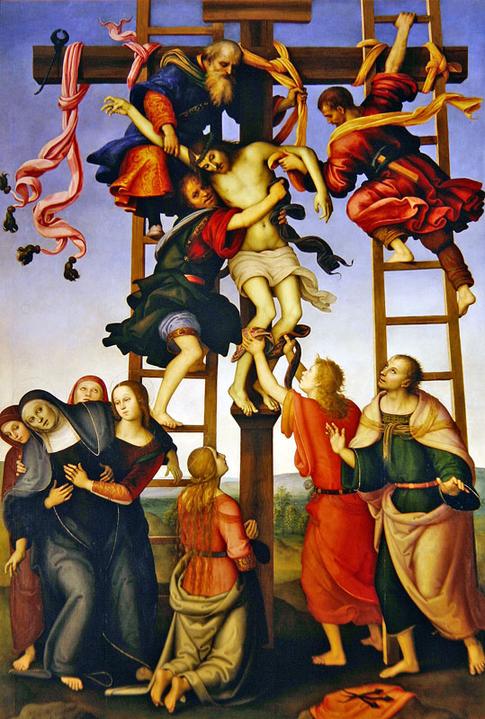 Also, Lippi's Deposition from the Cross (1504-7). This is a work I studied pretty carefully for my art history class last winter, and it really struck me when I saw it in person because Mary (bottom left) is utterly green, which just doesn't transfer into photos and reproductions very well. She stands out against all the other, more realistically colored, figures, and her grief seems all the more real for her unreal coloring.
 I also particularly enjoyed Pieri's Deposition (1587) because of its motion. It has a very circular element, drawing the eye from the top left, at Mary's head, around the curve of her body toward the middle of the composition and Christ's head, and then along his body line around to his feet at the bottom left. The extreme tilt of Mary's head, echoing that of Christ, as well as the similarities in the positions of both of their right arms, clearly draws them apart from the other onlookers in the scene who reinforce, but do not replicate, the clockwise motion created by the Virgin and Christ.
One of my favorite things about the Accademia is the presentation of David as a kind of god. The layout of the room he is in mirrors the layout of a basilica, with a long nave and a transept, placing David, on top of an altar-like pedestal with expensive porphyry marble inlays, at their intersection (the place of the high altar of a basilica) in front of what can only be described as an apse. Where there would ordinarily be chapels or oratories in a basilica are placed Michelangelo's unfinished Prisoner sculptures. I absolutely love these. They give real insight into the way Michelangelo worked, and it's incredible to see markings in the stone, invisible in a polished, finished work, from his chisel. I could almost hear and see him working away on the marble as I stood in the museum. I felt as though the sculptures were about to come alive and step out of the marble, a la Pygmalion.
Of course David is amazing. I cannot even begin to put it into words, and I'm not going to try.
Thursday, October 20, 2011
...in which I don't talk about Italy at all.
This is off topic, but I feel the need to say it anyway.
When I got home from class today, there were unsubstantiated reports that Gaddafi had been killed. Then I took a nap. I woke up to find that story confirmed and all over the internet, and I have three brief things to say about it. I'm no current events/world politics expert by any means, so forgive me my naïveté.
First, I think it's important that this was done by the Libyan people themselves. They started the uprising, they installed their own interim government, and they killed their tyrant, similar to the situation in Egypt and the other nations involved in the Arab Spring revolts. Iraq is a great counterexample; the United States had it's nose in all of Iraq's business, which is why, in my opinion, the situation has been so prolonged and messy. It harkens back to decolonialization problems in Africa: when and how does a nation leave another? I just feel that it is not the place of the US, or any powerful Western nation, to claim to understand the sentiments of and be able to aid the changes happening in the Arab world. So props to the Libyans who fought for their own freedom in their own country.
Second, I feel like the world is about to boil over. There have been so many protests and big movements of late. I could just be more attuned to them now than in the past because I'm older and more aware of world news, but something powerful seems to be happening. From immigration marches in the US, to the Arab Spring movements, to the Global Occupy movement, it really feels like someone has lit a fire under everyone's asses, and it's kind of exciting in a watch-from-my-couch sort of way.
Lastly, being the history nerd that I am, I'm intrigued by the label that has been put on this movement, the "Arab Spring". I can't help but be interested in the fact that the next generation will be memorizing that term for their world history classes. It blows my mind a little bit. It also makes me think about the history I study. For example, "Renaissance", renascimento, these are 18th century labels put on an era by a historian named Jacob Burkhardt. And we learn about what was called the Great War while it was happening as the First World War. So how do we label things to study them? Is it fair to think about things in terms of late labels given them by historians? And how does this work when Western news outlets label movements in the Arab world? How can we conceptualize the events happening in Libya, both as they relate to us as the so-called Arab Spring, and as they are being experienced by the Libyans, who, as far as I can guess, are not thinking about this movement in those terms? Something I just can't not think about.
When I got home from class today, there were unsubstantiated reports that Gaddafi had been killed. Then I took a nap. I woke up to find that story confirmed and all over the internet, and I have three brief things to say about it. I'm no current events/world politics expert by any means, so forgive me my naïveté.
First, I think it's important that this was done by the Libyan people themselves. They started the uprising, they installed their own interim government, and they killed their tyrant, similar to the situation in Egypt and the other nations involved in the Arab Spring revolts. Iraq is a great counterexample; the United States had it's nose in all of Iraq's business, which is why, in my opinion, the situation has been so prolonged and messy. It harkens back to decolonialization problems in Africa: when and how does a nation leave another? I just feel that it is not the place of the US, or any powerful Western nation, to claim to understand the sentiments of and be able to aid the changes happening in the Arab world. So props to the Libyans who fought for their own freedom in their own country.
Second, I feel like the world is about to boil over. There have been so many protests and big movements of late. I could just be more attuned to them now than in the past because I'm older and more aware of world news, but something powerful seems to be happening. From immigration marches in the US, to the Arab Spring movements, to the Global Occupy movement, it really feels like someone has lit a fire under everyone's asses, and it's kind of exciting in a watch-from-my-couch sort of way.
Lastly, being the history nerd that I am, I'm intrigued by the label that has been put on this movement, the "Arab Spring". I can't help but be interested in the fact that the next generation will be memorizing that term for their world history classes. It blows my mind a little bit. It also makes me think about the history I study. For example, "Renaissance", renascimento, these are 18th century labels put on an era by a historian named Jacob Burkhardt. And we learn about what was called the Great War while it was happening as the First World War. So how do we label things to study them? Is it fair to think about things in terms of late labels given them by historians? And how does this work when Western news outlets label movements in the Arab world? How can we conceptualize the events happening in Libya, both as they relate to us as the so-called Arab Spring, and as they are being experienced by the Libyans, who, as far as I can guess, are not thinking about this movement in those terms? Something I just can't not think about.
Monday, October 17, 2011
Coffee e cornetto: A brief note
Something the US needs to get behind: super cheap and delicious cappuccinos and pastries. The coffee here is FAR superior to anything in the States, and only costs .80EUR. Why is coffee stateside so overpriced and sugared up?! I can already tell that I'm going to miss the Italian breakfast tradition: go to the local bar (here bars function as coffee bars during the day), pay first, then go up to the bar, get your coffee, drink it while standing and chatting with people, munch on a croissant filled with chocolate, and then go about your day. It is one of my favorite things ever. Get on it, America!

Sunday, October 16, 2011
Chocolate and Chaos
Yesterday was delicious. Yes, delicious. I hopped on a train with the roommates to Perugia, the capitol of the region Umbria, which is famous for it's chocolate. Every year for they host EuroChocolate, a GIANT international open air festival centered around chocolate. There are thousands of vendors, a million visitors, and more chocolate than is easily conceivable. We arrived and were amazed. I ate a lot of free samples, bought a lot of not so free chocolate goodies, and ate a Nutella-filled cornetto (croissant). We also bought the local lunch standard, porchetta, which is sliced wild boar, served panino-style. It was incredibly tasty. Perugia is, also, gorgeous, so the day was amazing overall.
When we got back to Roma, dragging ourselves out of the Termini train station to wait for our bus home, we saw a lot of Carabinieri. (They're like cops, but all they do is keep the peace and control tourists. The equivalent of traffic cops are the polizia.) There were also news crews and helicopters. We continued to see Carabinieri everywhere on our bus ride home, and even a Carabinieri van badly burnt on the street. Naturally we were confused and looked up the news when we got home. The Global Occupy movement has come to Roma, a city that likes to protest and strike at any opportunity. (I've encountered 3 public transit strikes, a protest of firemen, and several political protests in the past 3 weeks.) The initially peaceful protest was co-opted by anarchists and became a full-out riot. Shop windows were smashed, tear gas was used, cars were lit on fire, Molotov cocktails flew...Rome really was burning,from Termini (the second busiest train depot in Europe) down Via Cavour (a main drag through the city) to Piazza Venezia (one of the biggest piazze, and an always crowded area). Several people were badly injured and hospitalized, but thankfully no one died. It was striking to watch news coverage of a city on fire after having just crossed it via bus. I've never been so close to that kind of event before. It's both scary and exciting; the world is really fed up with the status quo, and people across the first world are fighting back. It really is turning into a global movement. I think that's kind of cool, but I also worry that other cities will follow Rome's violent example, not to mention that I worry about friends in Chicago; CPD has started arresting some protesters there, and I have several friends heavily involved in the Occupy Chicago movement. Hopefully the "99%" will manage to get their message across without causing too much damage to their cities or to themselves. That being said, I agree with the message of the movement and am interested to see what will happen in the coming weeks. Be safe, everyone.
Wednesday, October 12, 2011
Ruins, Turtles, and Time
Something very mundane happened today, but it has really made me think. You know, because I'm a nerd and all that.
My civilizations class was tramping through ruins for the umpteenth time. Today we were in Tivioli, at the Villa Adriana, the emperor Hadrian's summer Villa turned permanent residence. He had this giant manmade pond built outside of the triclinium (dining room, basically) that had columns and arches and statues surrounding it, a few of which remain. A lot of times I find ruins like this eerie, especially when mostly bereft of tourists. They seem so dead and sterile; hard like the marble and brick they're constructed of. But today, beside that pond, there was a young turtle sunning himself and warily watching a class of 28 parade past his favorite spot. The juxtaposition of color against white marble, life against sterility, the new against the ancient, was striking. It made the enormity of the meaning of 2,000 years really hit me, and I haven't been able to shake a sort of weighty feeling about it ever since. That many years does a lot to make my own silly life seem like less than a speck of dust in the sands of time. Italy is certainly good at giving me a big doses of perspective.
(Again, not my picture.)

My civilizations class was tramping through ruins for the umpteenth time. Today we were in Tivioli, at the Villa Adriana, the emperor Hadrian's summer Villa turned permanent residence. He had this giant manmade pond built outside of the triclinium (dining room, basically) that had columns and arches and statues surrounding it, a few of which remain. A lot of times I find ruins like this eerie, especially when mostly bereft of tourists. They seem so dead and sterile; hard like the marble and brick they're constructed of. But today, beside that pond, there was a young turtle sunning himself and warily watching a class of 28 parade past his favorite spot. The juxtaposition of color against white marble, life against sterility, the new against the ancient, was striking. It made the enormity of the meaning of 2,000 years really hit me, and I haven't been able to shake a sort of weighty feeling about it ever since. That many years does a lot to make my own silly life seem like less than a speck of dust in the sands of time. Italy is certainly good at giving me a big doses of perspective.
(Again, not my picture.)
Monday, October 10, 2011
Happiness in a Keyhole
I am such an easily-pleased person. I was having a 'meh' kind of weekend up until this afternoon; I was sick and tired and sore and unable to escape my roommates (whom I really like, but you know...some days you hardcore need hermit-mode.) At any rate, I was very cranky when I left my Italian class today, which is silly; who wants to be cranky in Rome?!
Sarah, Tammy, Jan and I decided to go on an adventure, to walk around on the Aventine Hill, a part of the city none of us had explored yet. At the top of the hill is the teeny sovereignty of the Knights of Malta. In a gate in one of their walls is a keyhole that looks clear across the city to St. Peter's. You literally look across 3 countries to do this: Territory of the Knights of Malta, Italy, and the Vatican. We stood in line to see it, and it was fantastic. Not to mention that the Aventino neighborhood is beautiful and quiet. (A quiet area is a rarity in this crazy city.) The weather is finally cooler, there was a nice breeze, and the view was awesome. It took just this to completely turn my mood around. I need to always remember to appreciate small things, like staring at St. Peter's across the city through a keyhole. That's how small a thing it takes to make me happy: it can fit in a keyhole. And I consider myself lucky for that.
(I stole this picture because it's better than mine. The black stuff you see around the greenery is the keyhole.)

Sarah, Tammy, Jan and I decided to go on an adventure, to walk around on the Aventine Hill, a part of the city none of us had explored yet. At the top of the hill is the teeny sovereignty of the Knights of Malta. In a gate in one of their walls is a keyhole that looks clear across the city to St. Peter's. You literally look across 3 countries to do this: Territory of the Knights of Malta, Italy, and the Vatican. We stood in line to see it, and it was fantastic. Not to mention that the Aventino neighborhood is beautiful and quiet. (A quiet area is a rarity in this crazy city.) The weather is finally cooler, there was a nice breeze, and the view was awesome. It took just this to completely turn my mood around. I need to always remember to appreciate small things, like staring at St. Peter's across the city through a keyhole. That's how small a thing it takes to make me happy: it can fit in a keyhole. And I consider myself lucky for that.
(I stole this picture because it's better than mine. The black stuff you see around the greenery is the keyhole.)
Saturday, October 8, 2011
Only in Italy; a Vignette
A short story to give you a good idea of how Italy operates.
Today I was on a train headed to Rome from Naples after a class trip to the Bay of Naples area. At about the third station after leaving Naples the train stopped, as it was meant to...and failed to start again. After about 10 minutes, we were all a little confused, but went on with our conversation. (Trains stop at stations for longer intervals here than in America, so that time isn't too absurd.) By 20 minutes, we were getting a little antsy. Around 25 minutes, the Italians on the train started to get confused, too. No announcement was made. No conductor came around to let us know what was happening. Everyone sat in a state of more or less content confusion. Finally, after 30 minutes the Italian family in our car walked up to the front of the train to ask what was going on. No one knew. 5 minutes later we were finally told to get off the train and wait for another at a different track, with no explanation. 20 minutes after that, we, and everyone else from our train, boarded the other Rome-bound train. There was, overall, very little complaint and discontent. Were that to happen in the states, people would throw fits and demand refunds. Needless to say, Italy is wonderfully laid back and calm when it comes to this sort of thing. It's definitely a refreshing change that I'm trying to enjoy while I can.
Today I was on a train headed to Rome from Naples after a class trip to the Bay of Naples area. At about the third station after leaving Naples the train stopped, as it was meant to...and failed to start again. After about 10 minutes, we were all a little confused, but went on with our conversation. (Trains stop at stations for longer intervals here than in America, so that time isn't too absurd.) By 20 minutes, we were getting a little antsy. Around 25 minutes, the Italians on the train started to get confused, too. No announcement was made. No conductor came around to let us know what was happening. Everyone sat in a state of more or less content confusion. Finally, after 30 minutes the Italian family in our car walked up to the front of the train to ask what was going on. No one knew. 5 minutes later we were finally told to get off the train and wait for another at a different track, with no explanation. 20 minutes after that, we, and everyone else from our train, boarded the other Rome-bound train. There was, overall, very little complaint and discontent. Were that to happen in the states, people would throw fits and demand refunds. Needless to say, Italy is wonderfully laid back and calm when it comes to this sort of thing. It's definitely a refreshing change that I'm trying to enjoy while I can.
Wednesday, October 5, 2011
Tuscany: Pisa, Cinque Terre, and Lucca
Last weekend was incredible. Absolutely incredible. My (very awesome) roommates and I decided to head northwards, to northwestern Tuscany. We hauled ourselves out of bed at 4am (there were serious struggles happening) and managed to get to Termini (the central train station in Roma) and on our 6:00 train to Pisa. Once there, we wandered a bit (a lot; we get lost sometimes) and headed to the Piazza dei Miracoli. After discovering that the torre leans a lot more in real life than in pictures, we went into the battistero and the cattedrale. Both of those edifices are super interesting because they have a lot of Eastern influences (ie arched windows) mixed in with their traditional Pisan Romanesque style. Il battistero has an absolutely huge baptismal font directly under the vaulted dome, and once an hour a security guard stands almost in the center and sings. The acoustics are amazing; the tones overlap and reverberate until her one voice sounds like five or six. While she was singing everyone in the battistero shut up and watched her in awe. It was amazing. After exploring around a bit, we headed to la cattedrale. I was particularly fascinated by the doors; there are an older pair on the back and more recent editions to the front. I had a nerd moment and enjoyed comparing the different uses of space and perspectival strategies. When we were done at the cattedrale we moved on to our hostel, where we got a delicious homemade dinner for just the price of our drinks. Italy calls that an aperitivo; it's meant to just be pre-dinner drinks and a buffet, but you can definitely make a meal of it.
On Saturday morning we got up early (again) to catch a train to La Spezia, a small town and regional train hub, to buy tickets to the Cinque Terre park trail. Cinque Terre is a series of five lovely little villages along Italy's northwestern coast connected by hiking trails through the mountains. We hiked the length of the easiest trail (about 11km), stopping in each town as we went. The view along the Ligurian coast is legitimately one of the most gorgeous things I've ever seen. The water is a deep, clear blue (not teal like in Greece, but straight up blue) and the plants along the mountain side are vibrantly green. A lot of locals have small vineyards planted amongst the wild plants in the mountains as well, and the houses in the villages are all painted in bright colors that are reminiscent of the flowers surrounding them, which makes for quite a scenic hike. Also, the food in Tuscany is amazing; I ate the best focaccia of my life on that hike. I also had a dumb moment: my friend Sarah and I had been talking about cactus fruit. She's from California, where it is a common food, but I've never eaten one. So, naturally, when we came across a cactus with ripe fruit along the trail we decided to pick some. This was a BAD IDEA. I am still picking needles out of my hand, 4 days later. Whoops.
Once we finished the hike, which proved to be really pretty difficult, we spent some time on the beach and then headed back to La Spezia to get a train to Lucca, where we had hostel reservations for the night. Lucca is about an hour inland of Pisa, southeast of La Spezia. It is still entirely within its medieval city walls, and just about the greatest town I've seen. The people were incredibly friendly, our hostel was quirky and amazing, and the town is beautiful. On Sunday we came across an open air market selling everything from frate (it's like a lemony sugar doughnut that you can get dipped in warm Nutella) to 2 euro bras to pretty scarves and jewelry. We also walked along the city wall and wandered into the cattedrale, where we saw a Tintoretto. By the end of the day we were completely exhausted, but getting back to Rome from Lucca requires that you stop in Pisa; it was rather late when we finally dragged ourselves up the stairs of our apartment, but the weekend was well worth the exhaustion.
Side note: I love the ease with which one can get from place to place and find a place to crash in in Europe. It takes very little planning and very little money to get on a train and sleep in a hostel. America should really work on that.
On Saturday morning we got up early (again) to catch a train to La Spezia, a small town and regional train hub, to buy tickets to the Cinque Terre park trail. Cinque Terre is a series of five lovely little villages along Italy's northwestern coast connected by hiking trails through the mountains. We hiked the length of the easiest trail (about 11km), stopping in each town as we went. The view along the Ligurian coast is legitimately one of the most gorgeous things I've ever seen. The water is a deep, clear blue (not teal like in Greece, but straight up blue) and the plants along the mountain side are vibrantly green. A lot of locals have small vineyards planted amongst the wild plants in the mountains as well, and the houses in the villages are all painted in bright colors that are reminiscent of the flowers surrounding them, which makes for quite a scenic hike. Also, the food in Tuscany is amazing; I ate the best focaccia of my life on that hike. I also had a dumb moment: my friend Sarah and I had been talking about cactus fruit. She's from California, where it is a common food, but I've never eaten one. So, naturally, when we came across a cactus with ripe fruit along the trail we decided to pick some. This was a BAD IDEA. I am still picking needles out of my hand, 4 days later. Whoops.
Once we finished the hike, which proved to be really pretty difficult, we spent some time on the beach and then headed back to La Spezia to get a train to Lucca, where we had hostel reservations for the night. Lucca is about an hour inland of Pisa, southeast of La Spezia. It is still entirely within its medieval city walls, and just about the greatest town I've seen. The people were incredibly friendly, our hostel was quirky and amazing, and the town is beautiful. On Sunday we came across an open air market selling everything from frate (it's like a lemony sugar doughnut that you can get dipped in warm Nutella) to 2 euro bras to pretty scarves and jewelry. We also walked along the city wall and wandered into the cattedrale, where we saw a Tintoretto. By the end of the day we were completely exhausted, but getting back to Rome from Lucca requires that you stop in Pisa; it was rather late when we finally dragged ourselves up the stairs of our apartment, but the weekend was well worth the exhaustion.
Side note: I love the ease with which one can get from place to place and find a place to crash in in Europe. It takes very little planning and very little money to get on a train and sleep in a hostel. America should really work on that.
Monday, September 26, 2011
History and Mapless Adventures
I LOVE THIS CITY.
For real.
If I wasn't already a history dork, I would be after this trip. It fascinates me that I can walk around a crowded city corner and find ancient ruins waiting. I look at a crumbling column and can't help but stop and think about it's life. A lot of people respond to that by saying that a column is just some old stone that's falling over, but that's not what I see. I see the person who conceived of the idea and then brought it to life. I see the people who walked past it every day and didn't think twice, because it was simply part of their world. I see the guy leaning against it while he talked to a friend, or the kids playing next to it, or the stray dog sniffing it. And then I see it neglected and forgotten, slowly buried by layers of sediment from the Tiber, falling to bits as people continue to walk by and not care. And then, thousands of years later (Stop and really think about that. THOUSANDS of years.) someone is trying to build a new house or street and finds this old decrepit column and thinks it's special. Suddenly there are more people, digging, guessing about the guy, the kids, the dog, and the real purpose of that chunk of column. And now there's us, looking at it as a way to reflect on the past, or maybe just walking by and not caring. It's incredible, all the stories that piece of stone has seen, creating it's own story. I can't get over it. And I'm surrounded by thousands of these ruins, churches, and buildings. I'm slowly realizing that I could never get enough of this place.
That being said, I've done some pretty cool things so far. My apartment is in the Monteverde neighborhood, which is mostly just normal Italian people, but also includes a lot of the American University in Rome students. We're near Trastevere, which is a little touristy, but also amazing. It has a ton of shops and good little restaurantes. Trastevere translates to "across the Tiber"; the area is just south of the Vatican, across the river from the centro storico. I'm slowly (SLOWLY) learning how to buy groceries and cappuccinos without making a fool of myself. That, I believe, will take awhile. The Italians are friendly so long as I try to speak in there language, though, and when that fails they're more forgiving towards Spanish rather than English, which is nice.
I've spent a lot of time wandering in order to get to know the city. By wandering, I literally do mean wandering; we go out with a general idea of the area we want to see. Maps are put away, and we only look at them once we get home to see where it is that we actually went. By doing this I've made it to the Pantheon, the Spanish Steps, the Colosseum, the Forum, Palatine Hill, the Via del Corso (the equivalent of Chicago's State St.), Piazza Navona, the Castel Saint'Angelo, and the Piazza del Popolo. We've also found some places off the beaten path: the Pyramid, the Protestant Cemetery, the Basilica di Santa Maria in Trastevere (a 16th century basilica that was built on a 14th century church, that was built on a 2nd century pagan temple), and a lot of random fountains and statues. To do all of this, I've also learned about the public transportation, which makes me feel kind of accomplished. (It's the small things that are making me feel adjusted.) I've taken a tram, several buses, and the subway without getting lost, which is nice. The best way to get around the city is definitely walking, but sometimes the tram is a necessity. I'm feeling more and more comfortable with being here, and I think that feeling will only grow as I learn more Italian. Luckily, one of my roommates has taken several years of Italian, so she's helping me navigate the murky waters of the language barrier.
I'm off to cook myself some dinner, something else that I'm getting used to. Ciao!
For real.
If I wasn't already a history dork, I would be after this trip. It fascinates me that I can walk around a crowded city corner and find ancient ruins waiting. I look at a crumbling column and can't help but stop and think about it's life. A lot of people respond to that by saying that a column is just some old stone that's falling over, but that's not what I see. I see the person who conceived of the idea and then brought it to life. I see the people who walked past it every day and didn't think twice, because it was simply part of their world. I see the guy leaning against it while he talked to a friend, or the kids playing next to it, or the stray dog sniffing it. And then I see it neglected and forgotten, slowly buried by layers of sediment from the Tiber, falling to bits as people continue to walk by and not care. And then, thousands of years later (Stop and really think about that. THOUSANDS of years.) someone is trying to build a new house or street and finds this old decrepit column and thinks it's special. Suddenly there are more people, digging, guessing about the guy, the kids, the dog, and the real purpose of that chunk of column. And now there's us, looking at it as a way to reflect on the past, or maybe just walking by and not caring. It's incredible, all the stories that piece of stone has seen, creating it's own story. I can't get over it. And I'm surrounded by thousands of these ruins, churches, and buildings. I'm slowly realizing that I could never get enough of this place.
That being said, I've done some pretty cool things so far. My apartment is in the Monteverde neighborhood, which is mostly just normal Italian people, but also includes a lot of the American University in Rome students. We're near Trastevere, which is a little touristy, but also amazing. It has a ton of shops and good little restaurantes. Trastevere translates to "across the Tiber"; the area is just south of the Vatican, across the river from the centro storico. I'm slowly (SLOWLY) learning how to buy groceries and cappuccinos without making a fool of myself. That, I believe, will take awhile. The Italians are friendly so long as I try to speak in there language, though, and when that fails they're more forgiving towards Spanish rather than English, which is nice.
I've spent a lot of time wandering in order to get to know the city. By wandering, I literally do mean wandering; we go out with a general idea of the area we want to see. Maps are put away, and we only look at them once we get home to see where it is that we actually went. By doing this I've made it to the Pantheon, the Spanish Steps, the Colosseum, the Forum, Palatine Hill, the Via del Corso (the equivalent of Chicago's State St.), Piazza Navona, the Castel Saint'Angelo, and the Piazza del Popolo. We've also found some places off the beaten path: the Pyramid, the Protestant Cemetery, the Basilica di Santa Maria in Trastevere (a 16th century basilica that was built on a 14th century church, that was built on a 2nd century pagan temple), and a lot of random fountains and statues. To do all of this, I've also learned about the public transportation, which makes me feel kind of accomplished. (It's the small things that are making me feel adjusted.) I've taken a tram, several buses, and the subway without getting lost, which is nice. The best way to get around the city is definitely walking, but sometimes the tram is a necessity. I'm feeling more and more comfortable with being here, and I think that feeling will only grow as I learn more Italian. Luckily, one of my roommates has taken several years of Italian, so she's helping me navigate the murky waters of the language barrier.
I'm off to cook myself some dinner, something else that I'm getting used to. Ciao!
Tuesday, September 20, 2011
In the beginning...
[Disclaimer: I am very tired so this will probably be very corny. I apologize.]
I conveniently read that Eliot's Portrat of a Lady for the first time the other day, sitting on a bench on the University side of the quad while the Rock bells rang to signal the end of Opening Convocation and the beginning of the procession of the first years. Every year that moment seems like a definitive beginning...it's a start. It's the opening of the year, when everything is fresh and new. The first years look so confused and exhausted and excited. It was fortuitous that I was reading Eliot during that beginning, thinking about my own start during O-week two years ago, and my current beginning, happening right now. Going to Rome almost feels like going away to college for the first time. Just like I was two years ago, I'm expecting a lot of the upcoming months; I feel like it is a real step further into adulthood. This year truly feels that way, like the start of being a Real Person with Real Responsibilities. (How on earth did I end up having rent and gas payments?! I still refuse to believe that I am old enough to be entrusted with those kinds of responsibilities. Goodness.) As Eliot says, I will, "find so much to learn", not just about Roman history and pasta, but about myself. I want to use this quarter abroad as an opportunity to test myself, to shed the remnants of my sheltered suburban-ness that UChicago has not yet stamped out. That sounds corny: I want to Find Myself. It's such a cliche. But it is true, in a way. All of Europe feels like it's just right there, and all I have to do is leap. Or fly, I suppose. So here's hoping that I don't chicken out of doing anything I want to, that the food is good, that the people are better, and that my suitcase is within its allotted 50 pound limit. Arrivederci!
"'And so you are going abroad; and when do you return?
But that's a useless question.
You hardly know when you are coming back,
You will find so much to learn.'"
-T.S. Eliot, Portrait of a Lady
I conveniently read that Eliot's Portrat of a Lady for the first time the other day, sitting on a bench on the University side of the quad while the Rock bells rang to signal the end of Opening Convocation and the beginning of the procession of the first years. Every year that moment seems like a definitive beginning...it's a start. It's the opening of the year, when everything is fresh and new. The first years look so confused and exhausted and excited. It was fortuitous that I was reading Eliot during that beginning, thinking about my own start during O-week two years ago, and my current beginning, happening right now. Going to Rome almost feels like going away to college for the first time. Just like I was two years ago, I'm expecting a lot of the upcoming months; I feel like it is a real step further into adulthood. This year truly feels that way, like the start of being a Real Person with Real Responsibilities. (How on earth did I end up having rent and gas payments?! I still refuse to believe that I am old enough to be entrusted with those kinds of responsibilities. Goodness.) As Eliot says, I will, "find so much to learn", not just about Roman history and pasta, but about myself. I want to use this quarter abroad as an opportunity to test myself, to shed the remnants of my sheltered suburban-ness that UChicago has not yet stamped out. That sounds corny: I want to Find Myself. It's such a cliche. But it is true, in a way. All of Europe feels like it's just right there, and all I have to do is leap. Or fly, I suppose. So here's hoping that I don't chicken out of doing anything I want to, that the food is good, that the people are better, and that my suitcase is within its allotted 50 pound limit. Arrivederci!
Subscribe to:
Posts (Atom)